
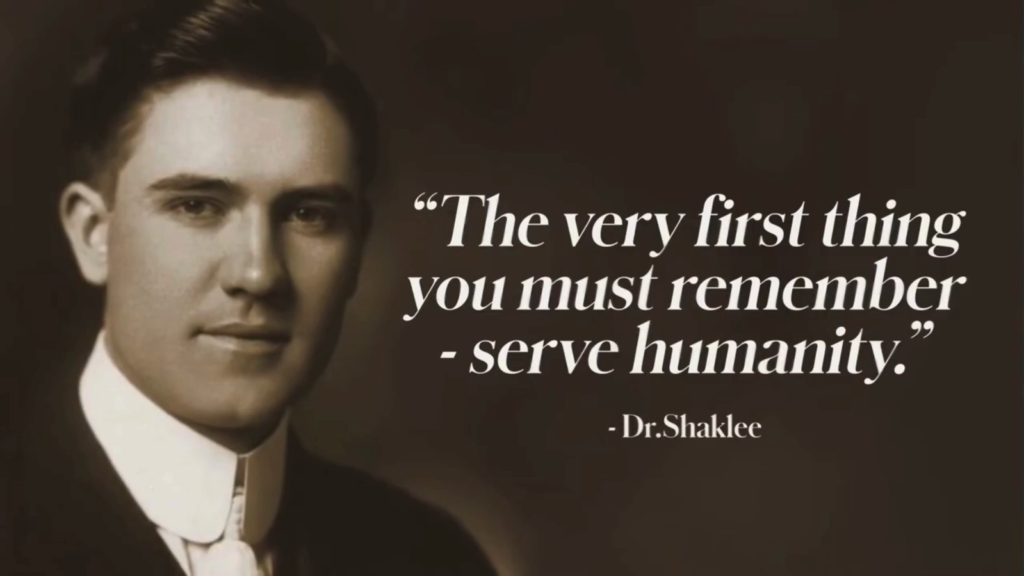
Who Is Dr. Forrest C. Shaklee?
Born to die at eight years old, he became the man who invented the multivitamin, healed himself from terminal cancer, pastored a church, built a 32-room medical clinic, and founded one of the world’s most enduring wellness companies — all before the age of 62.
In April 2026, Shaklee Corporation marked its 70th year in business — a milestone that very few companies in any industry ever reach. The 70th Anniversary Shaklee Conference is being held in Nashville, Tennessee, described by Shaklee as “a historic celebration 70 years in the making.” It is a moment worth pausing on. Because the story of how Shaklee began — the story of its founder, Dr. Forrest Clell Shaklee — is one of the most remarkable in the history of wellness, and most people have never heard it properly told.
This is that story.
🎉 Shaklee turns 70 in 2026
Founded April 1, 1956. Seventy years of science, nature, and people helping people. Now in New Zealand for the first time — and we’re just getting started.
Shop Shaklee NZ →Part One: Born to Die — Iowa, 1894

Shaklee through the years.
Forrest Clell Shaklee was born on November 27, 1894, in Carlisle, Iowa, to farmers Robert and Martha Shaklee. The midwife who delivered him made an immediate diagnosis: tuberculosis. The doctors who examined the infant concurred and delivered a prognosis that must have devastated his parents: this child would not live to see his eighth birthday.
The family’s response was practical and, as it turned out, prescient. They moved away from the soot and coal dust of the Carlisle coal mines to cleaner air in northern Iowa. Their prescribed treatment — the only one available for tuberculosis at the time — was good food, fresh air, and lots of rest.
Most of young Forrest’s childhood was spent convalescing. He lay outside on sunny days, watching the world. He observed animals — how they found food, how they healed, how they moved through nature without overthinking it. One realisation planted itself early and never left him: “Animals listen to the voice of nature,” he later wrote, “while men have forgotten how.”
By his teenage years, his doctors declared the tuberculosis arrested. He was frail compared to his peers, but he was alive. More than alive — he was curious, driven, and quietly burning with questions about why food and nature and the human body worked the way they did.
The boy they expected to bury before his eighth birthday would live to 91.
Part Two: The Making of a Healer — Three Philosophies, One Man
As a young man, Forrest Shaklee was drawn to three intellectual currents that would define his entire life.
The first was the teaching of Bernarr MacFadden, the controversial American health crusader whose magazine Physical Culture Shaklee read voraciously. MacFadden’s central argument was radical for its time: “Drugs often mask the symptom, without curing the disease.” For Shaklee, who had already experienced firsthand the power of food and fresh air over illness, this resonated deeply. He began to believe that genuine healing came not from suppressing symptoms but from giving the body what it needed to heal itself.
The second was the growing science of chiropractic care. Shaklee enrolled at the Palmer School of Chiropractic, founded by B.J. Palmer, the leading institution in the field. He was a dedicated student, but he disagreed with Palmer on a crucial point: Palmer believed chiropractic was the singular solution to physical illness. Shaklee believed the body needed a more complete system of support — structural, nutritional, and mental. He was already thinking in whole-person terms when the rest of medicine was thinking in single-discipline terms.
The third was the emerging science of nutrition itself. In 1912, Shaklee read about the discoveries of the Polish biochemist Casimir Funk, who had isolated natural substances from food that he called “vitamines.” Shaklee wrote to Funk directly, corresponding with him and expressing keen interest in developing practical applications from his research. He wanted to know: could you put these nutrients in a concentrated form that people could take every day? Could you give the body, in a practical supplement, what modern diets were failing to provide?
He was 18 years old when he started asking that question. He would spend the rest of his life answering it.
Part Three: 1915 — The World’s First Multivitamin
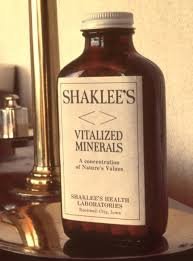
Shaklee's Vitalized Minerals — Dr. Forrest Shaklee's original formula, created in 1915.
In June 1915, Forrest Shaklee graduated from Palmer College of Chiropractic. He was 21 years old. The world was at war. The battlefields of Europe were consuming a generation. And in a small clinic in Iowa, a young chiropractor was doing something that no one had done before.
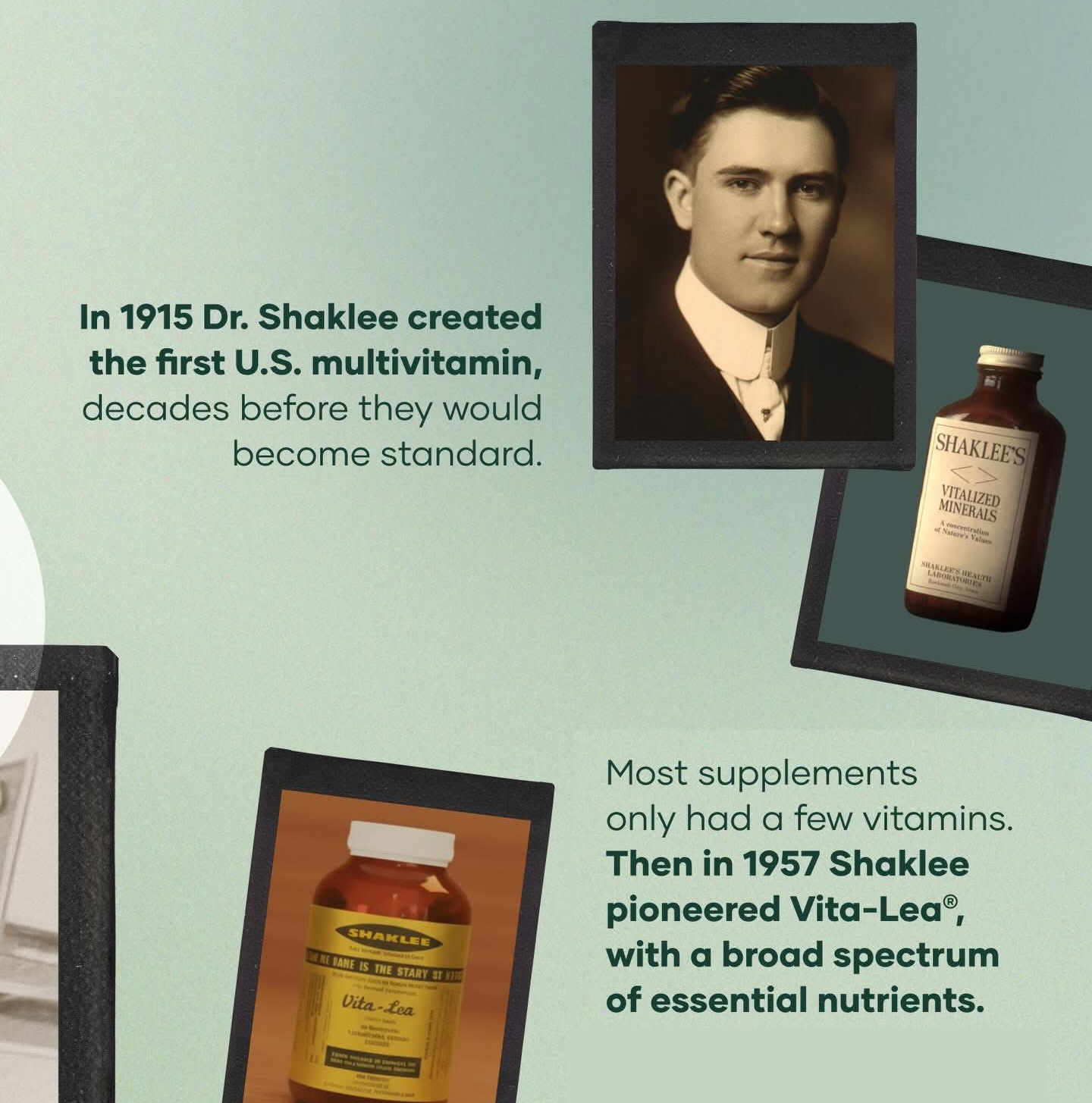
Drawing on years of reading, research, correspondence with Casimir Funk, and his own deep conviction that concentrated nutrition could change human health, Shaklee created Shaklee’s Vitalized Minerals — a concentrated, multimineral, nutritional supplement that was, by any reasonable measure, the first multivitamin ever formulated in the United States.
He began giving it to his patients immediately. He had seen them at Palmer — patients who were, in his own words, “undernourished and overfed.” People eating plenty of calories but starving at the cellular level. He believed poor nutrition was a root cause of disease that nobody in mainstream medicine was properly addressing. Vitalized Minerals was his answer.
“Follow the laws of Nature and you’ll never go wrong.”
— Dr. Forrest C. Shaklee, Founder, Shaklee CorporationIn 2022, the World Records Union officially declared Dr. Forrest C. Shaklee “The creator of Shaklee’s Vitalized Minerals, the world’s first vitamin pill.” A century later, his instinct was formally confirmed: he had invented an entirely new category of human health.
Also in 1915, Forrest Shaklee married Ruth Chapin, a woman he met at a church function — a detail that says something about who he was. Chiropractor, nutritional pioneer, and churchgoer, all at once.
Part Four: The Clinic, the Church, and the Crisis
Shaklee through the years.
The years after 1915 were a time of extraordinary building. By 1916, at just 22 years old, Shaklee had purchased his first medical clinic. A year later, his first son, Forrest Jr., was born. In 1918, the family moved to Fort Dodge, Iowa, where Shaklee opened his second and much larger facility.
This was no ordinary clinic. It had 32 treatment rooms and a 15-bed sanatorium. Shaklee staffed it not just with chiropractors but with osteopaths, internists, general practitioners, and surgeons. He put his patients on vitamin-rich diets and began treating large volumes of people for nutritional deficiencies that mainstream medicine barely recognised as a category. The clinic was busy and prosperous. In December 1921, his second son, Raleigh, was born.
Forrest Shaklee was also deeply involved in his community’s spiritual life. In 1928, when a new church opened in Portland, Iowa, he was asked to serve as its full-time Sunday pastor. He accepted. In 1929, church elders officially ordained him as a minister. He had received a Doctor of Divinity degree and his sermons were widely attended. He was, simultaneously, a chiropractor with a thriving multi-specialty clinic, a nutritional researcher, a family man, and a pastor. The breadth of his life was remarkable by any standard.
But the crisis was coming.
At his Fort Dodge clinic, Shaklee had thrown himself into the emerging field of X-ray diagnosis — a technology so new that its hazards were almost entirely unknown. He spent enormous amounts of time operating X-ray equipment. By 1921, at just 27 years old, he was suffering from severe ulcerating burns on his left shoulder and left hip — the unmistakable result of radiation damage.
The diagnosis from the Mayo Clinic was devastating: terminal cancer. The recommended treatment was amputation of the left arm up to the shoulder and the left leg up to the hip.
Shaklee refused.
“Cancer will not cut my life short, and I will not become a helpless amputee. I will live. I will heal. I know I can do it.”
— Dr. Forrest C. Shaklee, 1921He sold the clinic and moved back to a farm in Davenport. He began an intensive, self-designed programme of fresh food grown directly from the soil, combined with large quantities of his own Vitalized Minerals supplement. For months, the outcome was uncertain. But Shaklee’s conviction never wavered — and over time, his body healed.
The man who had invented the world’s first multivitamin at 21 had, by his late twenties, used it to survive a cancer diagnosis that the best medical institution in America had declared terminal. His belief in nutritional science was no longer theoretical. It was personal. He had staked his life on it — and won.
Part Five: Rebuilding, Researching, and Finding Purpose
The years after his recovery were marked by restless reinvention. In 1928 a fire destroyed his Iowa clinic. Rather than rebuilding, Shaklee decided to see more of America. He moved his family to Eugene, Oregon, drawn by the rich soils and favourable growing conditions for the herbs and vegetables he wanted for his nutritional research. The rain was hard on his health, so he relocated again — this time to Oakland, California, which would become his permanent home.
In Oakland, Shaklee continued building. He opened the Shaklee Clinic, and by 1935 was also serving on the faculty of the California Chiropractic College as a Professor of Biochemistry. He held four degrees by this point: Professor of Chiropractic, Doctor of Naturopathy, Doctor of Divinity — and the degree that perhaps meant most to him, from the University of Iowa, in philosophy.
His research had also moved him into entirely unexpected territory. In addition to nutritional science, Shaklee was involved in ground-breaking work that contributed to the invention of a new form of synthetic rubber. His enquiring mind led him into contact with some of the most remarkable figures of the age — including Thomas Edison and Henry Ford, both of whom he met through the circuits of scientific and industrial research that connected curious minds in early twentieth-century America.
And then, in 1941, tragedy. His wife Ruth, the woman he had married the same year he invented the multivitamin, was killed by an automobile while crossing a street. Shaklee was 47 years old. He mourned deeply. And in the years of grief that followed, he began writing something that would prove to be the third great contribution of his life — after the multivitamin and the clinic.
Part Six: Thoughtsmanship — A Philosophy for Living
Forrest Shaklee had always believed that the body and the mind were connected — that wellness was not only physical but mental and spiritual. His tuberculosis recovery had depended on it. His cancer recovery had demonstrated it. Now, after Ruth’s death, he began codifying what he had spent his life observing and living into a formal philosophy he called Thoughtsmanship.
Thoughtsmanship was, at its core, a framework for how the quality of a person’s thoughts shapes the quality of their life. It was about becoming more aware of one’s emotions, surroundings, and the present moment. It was about the mind’s capacity to influence health, resilience, and outcomes. It was, in 1945, what we might today call mindfulness — except it was deeply practical, rooted in physiology as much as philosophy, and accompanied by a lifelong commitment to what Shaklee called Living in Harmony with Nature.
Shaklee wrote four volumes on Thoughtsmanship, published in 1951. He lectured to capacity crowds. His popular lectures were broadcast on radio stations in San Francisco and Oakland. The Commonwealth University of Los Angeles awarded him a Doctorate in Philosophy for the body of work. He also received the Doctor of Divinity degree, and had his name listed in Who’s Who in the West, Who’s Who in America, Who’s Who in the World, and the International Register of Profiles.
He also remarried. His second wife, Dorothy Potter, shared his later years.
By the time Forrest Shaklee was approaching 60, he had already lived several extraordinary lifetimes. He had been a dying infant, a tuberculosis survivor, a chiropractic pioneer, a nutritional inventor, a clinic builder, a pastor, a cancer survivor, a biochemistry professor, a rubber researcher, a philosopher, and a bestselling lecturer. He had met Edison and Ford. He had corresponded with Casimir Funk. He had built and lost and rebuilt.
And he was just getting to the part that would make him truly famous.
Part Seven: April 1, 1956 — Shaklee Corporation Is Born
Shaklee through the years.
In the autumn of 1955, Dr. Forrest Shaklee — now 62 years old, a grandfather, a philosopher, and a man whose entire life had been a sustained experiment in the power of nutrition — sat down with his two sons, Forrest Jr. and Raleigh, and told them what he wanted to do.
He wanted to start a company. He wanted to manufacture food supplements and distribute them across North America. He had been selling nutritional formulas to his patients since 1924. He had watched the public’s interest in nutrition grow slowly and then, in the post-war years, begin to accelerate. He had spent forty years proving — to himself and his patients — that nutrition changed lives. Now he wanted to scale that belief into something that could reach millions of people.
His instruction to his sons about how they would sell it was simple and profound: “We’ll teach some, and they’ll teach others.”
On April 1, 1956, Shaklee Corporation was formally incorporated. The company’s first product, Pro-Lecin Nibblers — a multivitamin made from protein, vitamins, and lecithin — was the first multivitamin created and formulated in the United States. Later that year, Shaklee introduced Vita-Lea, the multivitamin/multi-mineral tablet that is still sold by Shaklee today, more than six decades later. The company was founded on two principles that Dr. Shaklee insisted would never be compromised: the Golden Rule, and Living in Harmony with Nature®.
America believed itself to be the best-fed nation in the world. Every potential customer would need to be educated. Shaklee leaned into it: the company’s sales model was built not on advertising but on people sharing knowledge with the people around them. It was community marketing before anyone had named it that. You used the products. You experienced the results. You told someone you trusted. They told someone they trusted. Dr. Shaklee told his sons, “We’ll teach some and they’ll teach others.” That simple sentence is still the operating philosophy of two million Shaklee ambassadors worldwide today.
Part Eight: The Shaklee Effect — A Legacy Built Product by Product
Shaklee through the years.
What followed the 1956 founding was a cascade of firsts that reads, today, less like a corporate history and more like a preview of the world we now live in.
- 1915Shaklee’s Vitalized Minerals — the first multivitamin in the United States. A world record officially recognised in 2022.
- 1956Shaklee Corporation incorporated on April 1. Vita-Lea multivitamin introduced later that year — still sold today.
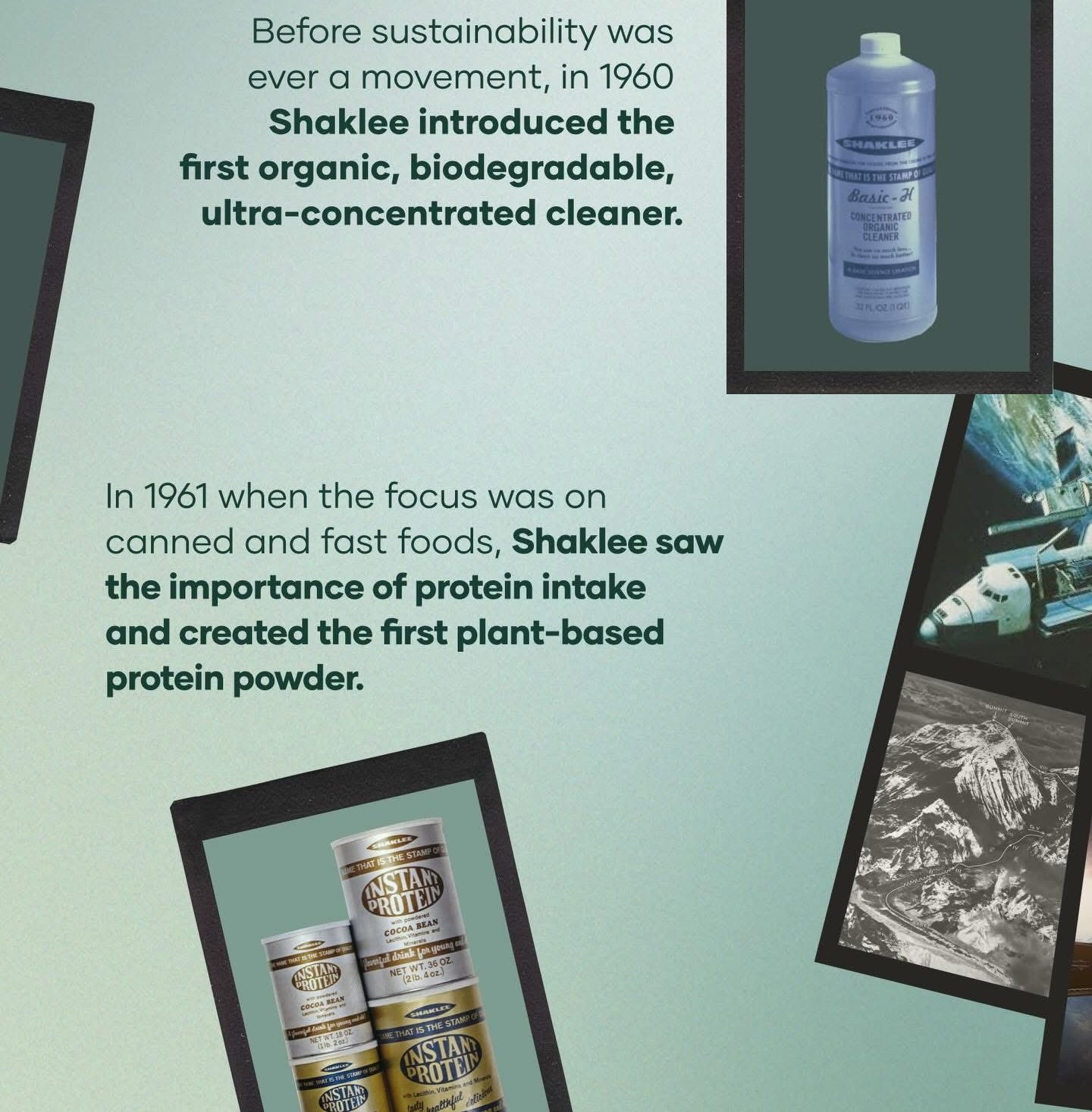
- 1960Basic-H® Concentrated Organic Cleaner introduced — one of the first non-toxic, biodegradable household cleaners in the world. A product so ahead of its time it was chosen as an official Earth Day product in 1990.
- 1961Instant Protein — one of the first soy protein isolate formulas in the world.
- 1972First phosphate-free laundry detergent. Decades before environmental labelling became mainstream.
- 1984Official Nutrition Consultant to the U.S. Olympic Team at the Winter Games in Sarajevo. The team wins more medals than any previous U.S. Winter Olympic team.
- 1990Basic-H® selected as one of the first official Earth Day products.
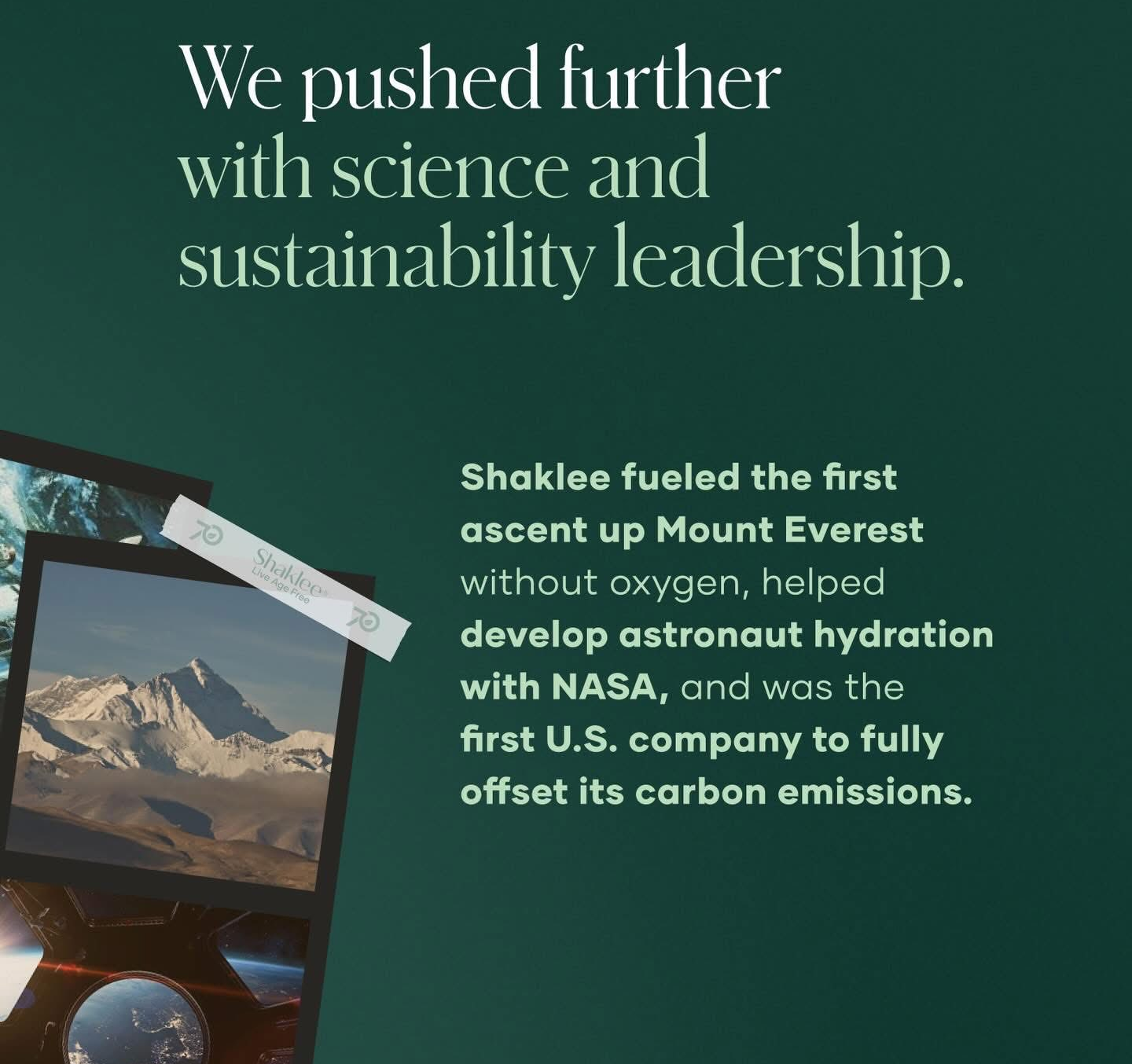
- 1993Shaklee products begin flying on every NASA mission. Scientists design AstroAde, a special rehydration product co-developed with NASA scientists to combat General Re-entry Syndrome. Shaklee products have been on every NASA mission since.
- 2000Shaklee becomes the first company in the world to be certified Climate Neutral, fully offsetting its carbon emissions. Net zero impact on the environment — twenty-two years before most of the world had heard the phrase.
- 2004Roger Barnett acquires Shaklee for $310 million. Over 110 published clinical studies. 70+ patents.
- 2007First consumer products company to operate on 100% green power. Partnership with Nobel Peace Prize laureate Dr. Wangari Maathai — one million trees planted.
- 2021Commitment to plant 10 million trees in 10 years. Over $10 billion in commissions paid to members globally.
- 202670th anniversary. Shaklee launches in New Zealand. The mission continues.

Shaklee through the years.
Part Nine: The Man Himself — Family, Faith, and a Life Without Compromise
It would be easy, reading this history, to abstract Forrest Shaklee into a symbol — the visionary founder, the pioneer, the world record holder. But the details of his life resist abstraction. They insist on a human being.
He was a farm boy from Iowa who grew up believing nature was the greatest healer. He married a woman he met at church and had two sons with her. He built a 32-room clinic and staffed it with five kinds of doctors because he thought the body needed all of them. He pastored a church on Sundays because his faith and his science were never in competition for him — they were both expressions of the same belief that the world was ordered, that living in harmony with that order produced health and flourishing, and that the highest thing a person could do was to help others do the same.
He survived tuberculosis because his family fed him well and let him breathe clean air. He survived terminal cancer because he refused to accept the diagnosis and used food and supplements to heal himself. He lost his wife to a random tragedy and responded not by hardening but by deepening — writing a philosophy of presence and awareness that became one of the most widely read wellness philosophies of mid-century America.
He met Thomas Edison and Henry Ford. He corresponded with Casimir Funk, the man who discovered vitamins. He taught biochemistry in California and lectured to capacity crowds in San Francisco and Oakland. He broadcast his philosophy on the radio. He published four books. He built a company at 62 that became the world’s most scientifically credentialled natural nutrition company.
He died on December 15, 1985, in Castro Valley, California — aged 91. The boy who was supposed to die at eight had lived for 91 years, and spent almost every one of them proving that nature, nutrition, and the human spirit were more powerful than any diagnosis.
“For 100 years now, Dr. Shaklee’s philosophy has guided everything we do. He believed that each of us could make a healthy difference in the world. His vision first took shape in 1915 with his development of one of the first multivitamins in the U.S. That vision took physical shape in 1956 when he founded Shaklee Corporation. We call it The Shaklee Effect — people taking small daily steps towards improving their own lives and the lives of others.”
— Shaklee Corporation2026: 70 Years On — And Just Beginning in New Zealand

Shaklee through the years — now in New Zealand.
In April 2026, Shaklee Corporation turns 70. The 70th Anniversary Conference is being held in Nashville, Tennessee — “a historic celebration 70 years in the making,” as Shaklee describes it. Ten thousand ambassadors, new product reveals, and a gathering of the two-million-strong Shaklee family from around the world.
And in New Zealand, we are at the very beginning of our chapter in this story.
The products Dr. Shaklee created — the multivitamin, the protein shake, the biodegradable cleaner — have been refined over 110+ published clinical studies and 70+ patents. They have been taken on every NASA mission since 1993. They have been trusted by US Olympic athletes. They are backed by a 100% money-back guarantee that has never been revoked. And they are now available in New Zealand, shipped from Auckland, with free lifetime membership included on your first order of $50 or more.
The boy from Carlisle, Iowa — the one who was supposed to die before his eighth birthday — started something in 1915 that is still running in 2026. That is what a truly great idea looks like. That is what a truly great life looks like.
Experience Shaklee in New Zealand
Shop the full Shaklee range at Shop Wellness NZ — your official Shaklee Ambassador. Free lifetime membership with your first order of $50+. Ships from Auckland, NZ-wide.
Shop Shaklee NZ →Sources: Forrest C. Shaklee, Wikipedia; Shaklee Corporation official history, fundinguniverse.com; Worldkings.org Forrest Shaklee world record declaration, March 1, 2022; Shaklee 65th anniversary press release, April 22, 2021; Shaklee Environmental Achievements, us.shaklee.com; Shaklee “65 Years of Making Healthy Happen,” shaklee.com, March 2023; Shaklee 70th Anniversary Conference announcement, events.shaklee.com, October 2025; NASA/Shaklee AstroAde partnership announcement, PRNewswire, April 2016; “Fascinating Story of Dr Forrest Shaklee,” my.vitamin.my; “A Tribute to a Great Man Dr. Forrest C. Shaklee,” slideplayer.com. All facts verified from authoritative sources. No fabrication.