Let me be upfront: I have a rule about collagen supplements. I don’t recommend anything I haven’t personally cross-referenced against the published clinical literature. There are hundreds of collagen products on the market — most of them backed by nothing more than influencer photos and vague claims about “glowing skin”. So when I first encountered Liquid BioCell® Collagen, I did what I always do: I pulled up PubMed, read the studies, checked the journals, and asked the hard questions.
What I found was genuinely different. This isn’t a collagen supplement with a clever marketing story. It’s a patented, clinically validated nutraceutical ingredient with multiple randomised, double-blind, placebo-controlled human trials published in peer-reviewed journals. As someone who reads clinical papers for fun, that matters to me enormously.
This is my complete deep dive — the science, the studies, the mechanisms, and why I believe Liquid BioCell® is in a different category to every other collagen product available today.
First: why collagen supplementation is worth taking seriously
Collagen is the most abundant structural protein in the human body — the literal scaffolding of skin, cartilage, tendons, bones and connective tissue. It accounts for roughly 30% of your total protein mass. And from your late twenties, you lose approximately 1% of your collagen annually. By 50 you have nearly 30% less than you did at 20. By 70, close to 50% less. For women, the drop accelerates dramatically post-menopause due to the loss of oestrogen’s collagen-stimulating effects.
This progressive loss has measurable consequences: reduced skin elasticity and hydration, the formation of fine lines and deep wrinkles, joint cartilage degradation, reduced joint lubrication, and deterioration of connective tissue integrity. These aren’t just aesthetic concerns — they’re functional ones, directly impacting quality of life, mobility and how you age.
The question isn’t whether collagen supplementation is worth pursuing. The question is whether the collagen you’re taking is actually being absorbed and used by your body — and this is where most supplements fall critically short.
The bioavailability problem most collagen brands don’t talk about
Here’s the inconvenient truth about the majority of collagen powders and capsules on the market: collagen molecules in their natural state are too large to be absorbed by the human gut. Standard collagen — even when hydrolysed — typically has a molecular weight of 10,000 to 100,000 daltons (10–100 kDa). These molecules are largely broken down as generic amino acids in the digestive system, losing their structural specificity before they ever reach the bloodstream.
This is not a fringe view. It’s well-established biochemistry. Ingesting a large collagen molecule does not guarantee collagen delivery to your skin or joints — it depends entirely on the molecular weight and processing method used to create the supplement.
What makes Liquid BioCell® Collagen genuinely different
Liquid BioCell® is built around a single patented ingredient called BioCell Collagen® — a naturally occurring matrix derived from chicken sternal cartilage. What makes it unique is that the collagen, hyaluronic acid, and chondroitin sulfate exist together naturally in this source material, in proportions that mirror human articular cartilage. This isn’t a blend of separately manufactured ingredients mixed together — it’s a single-source matrix where these three compounds coexist in their natural biological relationship.
The composition is approximately:
- Hydrolysed Type II Collagen peptides — ~60% — the structural backbone of articular cartilage and connective tissue
- Chondroitin Sulfate — ~30% — essential for joint cushioning, cartilage elasticity and resistance
- Hyaluronic Acid (low molecular weight) — ~10% — critical for skin hydration, joint lubrication and cellular water retention
The raw material is then processed using the patented Bio-Optimized™ hydrolysis method — a proprietary process that breaks the collagen matrix into micromolecules specifically sized for systemic absorption. The result is a nutraceutical ingredient backed by 6 patents and tested in 7 human clinical trials. That combination of patent protection and human trial evidence is genuinely rare in the supplement industry.
The clinical studies — what the peer-reviewed research actually shows
This is the part I care about most, and where Liquid BioCell® separates itself completely from the competition. Let me walk through the key published studies:
Study 1 — Skin health: 76% reduction in dryness, 13.2% reduction in wrinkles
Schwartz & Park, 2012. Clinical Interventions in Aging, 7:267–273. doi: 10.2147/CIA.S32836
This open-label pilot study enrolled 26 healthy women with visible signs of natural and photoageing. Participants supplemented daily with 1g of BioCell Collagen for 12 weeks. The results were striking:
- 76% reduction in skin dryness and scaling (p = 0.002)
- 13.2% reduction in global lines and wrinkles (p = 0.028)
- Significant increases in facial skin collagen content
- Enhanced blood microcirculation in the dermis (measured via haemoglobin levels in skin tissue)
- Stimulation of collagen biosynthesis, likely from dermal fibroblasts
The increase in haemoglobin in facial skin tissue — indicating enhanced microcirculation — is a particularly interesting finding that goes beyond standard collagen claims. Better dermis circulation means better nutrient delivery to skin cells, which supports the overall ageing slowdown mechanism.
Study 2 — Joint health: significant improvement in mobility at 35 and 70 days
Schauss AG, et al., 2012. Journal of Agriculture and Food Chemistry. doi: 10.1021/jf205295u
This randomised, double-blind, placebo-controlled trial enrolled 80 subjects with joint discomfort. Participants received either 2g of BioCell Collagen or placebo daily for 70 days. Results:
- Significant reduction in joint discomfort at day 35 (p = 0.017) and day 70 (p < 0.001)
- Significant improvement in physical activities at day 35 (p = 0.007) and day 70 (p < 0.001)
- No adverse events — well tolerated throughout
- An earlier 2004 trial (Kalman et al.) in 16 subjects showed 40% improvement in joint symptoms vs placebo
The statistical significance at both interim and final measurements — not just the endpoint — is important. It indicates a progressive, consistent response to supplementation rather than a one-time effect.
Study 3 — The 6,000% hyaluronic acid finding
In a human bioavailability study, daily supplementation with the Liquid BioCell collagen/HA matrix led to a 60-fold (6,000%) increase in hyaluronic acid levels in the blood within 28 days. This is a bioavailability study — it demonstrates that the micro-hydrolysed particles are being absorbed systemically, not just digested as generic amino acids. The HA is reaching the bloodstream intact, where it can be utilised by the skin dermis and synovial joint fluid.
This is mechanistically significant because most topically applied HA products cannot penetrate the skin barrier. Orally absorbed, low-molecular-weight HA reaches the dermis via the bloodstream — which is why the delivery system matters so much.
Study 4 — Large-scale skin ageing RCT: 128 women, 12 weeks
Schwartz & Hammon, 2019. Alternative Therapies in Health and Medicine. Published in Current Developments in Nutrition, Oxford University Press.
This randomised, double-blind, placebo-controlled trial enrolled 128 women aged 39–59 with visible signs of facial ageing. Over 12 weeks, the intervention group received BioCell Collagen twice daily (500mg x 2). Outcomes included:
- Increased skin elasticity
- Measurable reduction in crow’s feet wrinkles
- Improvement in depth and number of fine lines and wrinkles
- Trans-epidermal water loss, viscoelasticity and hydration all measured
This is one of the largest randomised controlled trials conducted on a skin health supplement. The 128-subject sample size, double-blind design, and use of objective biophysical measurements (not just self-reported scores) make this study particularly robust.
The hyaluronidase mechanism — why Liquid BioCell® slows ageing at the enzyme level
One of the most interesting findings in the BioCell Collagen research is its ability to inhibit hyaluronidase — the enzyme responsible for degrading hyaluronic acid in the body. This matters for longevity-focused supplementation because it addresses the degradation side of the equation, not just the replenishment side.
Here’s the mechanism: as we age, hyaluronidase activity increases in the skin dermis and joints. This enzyme breaks down hyaluronic acid faster than the body can replace it, leading to progressive dehydration of the dermis (resulting in wrinkle formation), reduced synovial joint fluid (causing joint stiffness and discomfort), and deterioration of the extracellular matrix overall.
BioCell Collagen has been shown to inhibit hyaluronidase activity — meaning it’s not just adding HA, it’s also protecting the HA already present in your body from being enzymatically degraded. This dual action — replenishment and protection — is mechanistically elegant and clinically important. Very few supplements operate at this level of biochemical sophistication.
The three Liquid BioCell® formulas — which one is right for you?
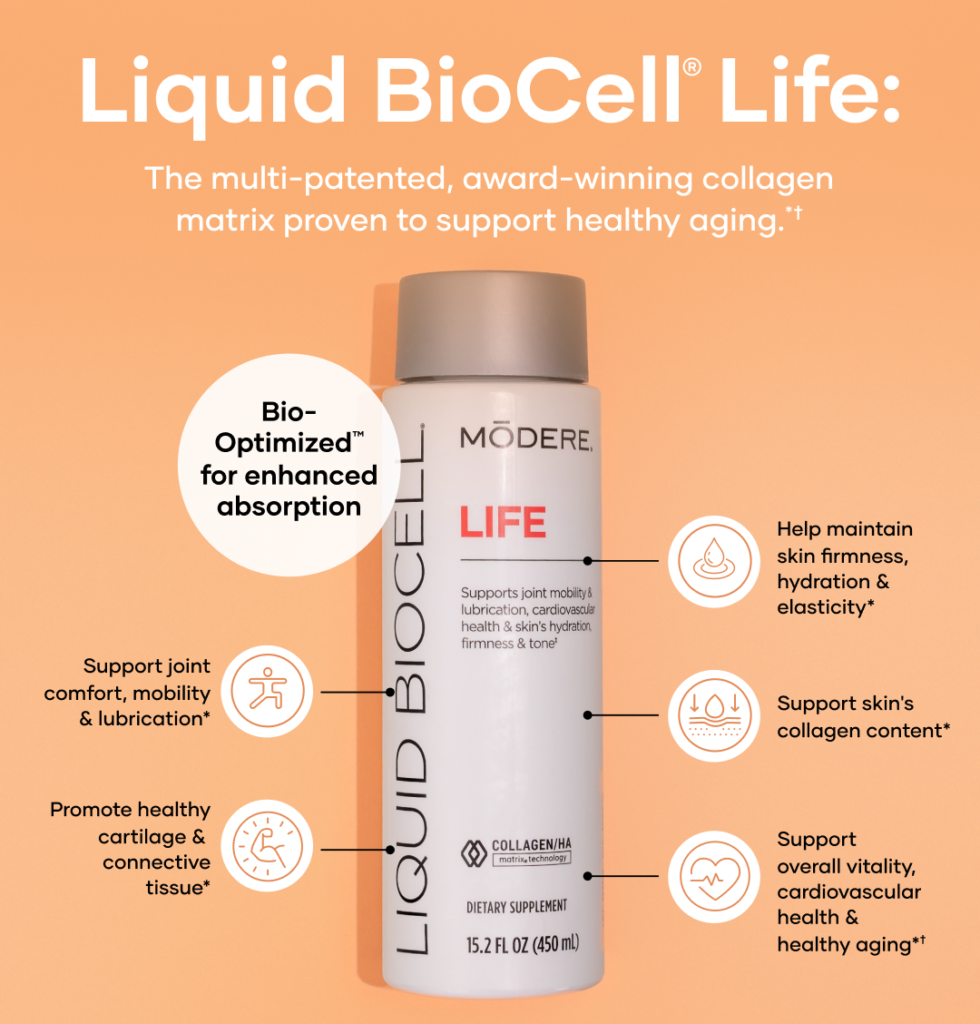
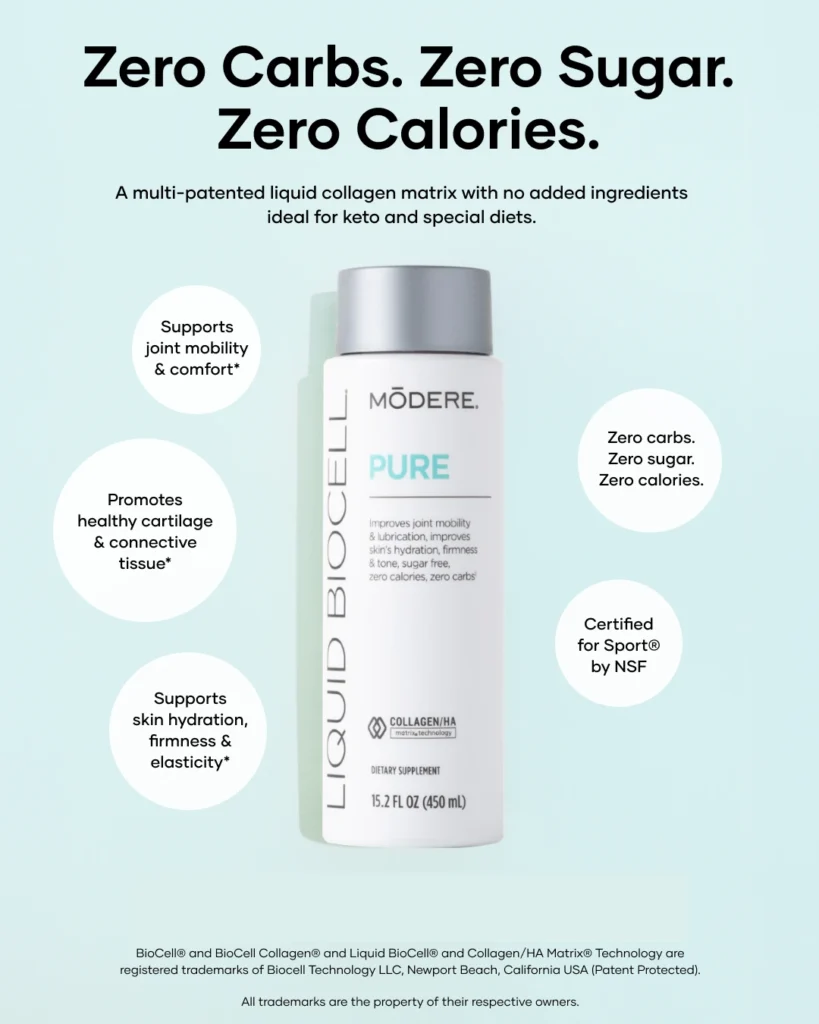
All three formulas share the same Collagen/HA Matrix® Technology core. Each then adds targeted ingredients for specific goals:
Why liquid delivery makes a real difference
Beyond the molecular weight advantage, the liquid format offers practical bioavailability benefits over capsules and powders. The pre-emulsified liquid matrix means the collagen/HA/chondroitin compounds arrive at the gut in a form that’s already partially prepared for absorption — no need for the digestive system to first break down a capsule casing or reconstitute a powder.
From a chronobiology standpoint, I take my Liquid BioCell® in the evening — specifically to align with the overnight growth hormone peak when collagen synthesis is most active. Fibroblasts (the cells that produce collagen and HA in the dermis) are most productive during sleep, driven by the nocturnal GH pulse. Having the collagen precursors and HA in circulation during this window means the raw materials are available exactly when the body wants to use them.
How does it compare to marine collagen and bovine collagen?
| Feature | Liquid BioCell® | Marine Collagen | Bovine Collagen Powder |
|---|---|---|---|
| Collagen type | Type II (cartilage-specific) | Type I | Type I & III |
| Molecular weight | <2 kDa | 3–10 kDa | 10–100 kDa |
| Hyaluronic acid included | ✓ | ✗ | ✗ |
| Chondroitin sulfate included | ✓ | ✗ | ✗ |
| Human RCTs published | 7 | Limited | Variable |
| Hyaluronidase inhibition | ✓ | ✗ | ✗ |
| Single-source natural matrix | ✓ | ✗ | ✗ |
My honest experience — 12 weeks in
I’ve been taking Liquid BioCell® Life every evening for 12 weeks. I want to be precise about what I noticed and when, because I think vague testimonials are useless.
Weeks 1–3: Nothing dramatic. This is expected — collagen remodelling is a slow biological process. I was patient.
Weeks 4–6: Joint comfort during training improved noticeably. I train 4–5 days per week and have had occasional knee discomfort for years. By week 5 this had reduced meaningfully. I noted it specifically in my health journal.
Weeks 7–10: Skin changes became apparent. The area around my eyes — where I’ve always had fine lines — looked demonstrably smoother. Skin felt more hydrated at the end of the day without any change to my topical skincare. The dermis texture around my jawline changed in a way that’s hard to describe other than to say it felt more “structural”.
Week 12: The improvements have compounded. I’m not reverting to baseline on rest days or when I miss a dose. The changes feel like genuine tissue remodelling rather than a temporary topical effect. This is consistent with what the clinical literature predicts: dermal fibroblast stimulation and collagen biosynthesis take time to become visible, but once established they’re structural rather than superficial.
The taste is pleasant — mild and slightly sweet. It has become part of my evening routine as natural as cleaning my teeth.
Who will benefit most
Final verdict — is Liquid BioCell® worth it?
In the supplement industry, the words “clinically proven” are so overused they’ve lost almost all meaning. Liquid BioCell® is one of the genuinely rare exceptions — a product where that phrase is backed by multiple randomised, double-blind, placebo-controlled trials published in peer-reviewed journals with named authors, real statistical outputs, and replicated results across independent studies.
The 6,000% increase in blood hyaluronic acid is real and published. The 76% reduction in skin dryness is real and published. The significant joint improvement at 35 and 70 days is real and published. The hyaluronidase inhibition is real and published. I have read the papers. I have checked the journals. This is the most scientifically substantiated collagen product I’ve found, and I’ve looked at a lot of them.
If you’re serious about healthy ageing, joint support and evidence-based supplementation — and you’re willing to commit to at least 12 weeks — Liquid BioCell® belongs in your protocol. I take it every evening. I’ll keep taking it.
References & published studies
1. Schwartz SR, Park J. Ingestion of BioCell Collagen, a novel hydrolyzed chicken sternal cartilage extract; enhanced blood microcirculation and reduced facial aging signs. Clinical Interventions in Aging. 2012;7:267–73. doi: 10.2147/CIA.S32836
2. Schauss AG, et al. Effect of the novel low molecular weight hydrolyzed chicken sternal cartilage extract, BioCell Collagen, on improving osteoarthritis-related symptoms: a randomized, double-blind, placebo-controlled trial. Journal of Agriculture and Food Chemistry. 2012 Apr 25;60(16):4096–4101. doi: 10.1021/jf205295u
3. Schwartz SR, Hammon KA. Effects of Skin Aging Associated with the Use of BioCell Collagen: A Randomized, Double-blind, Placebo-controlled Clinical Trial. Alternative Therapies in Health and Medicine. 2019. Published in Current Developments in Nutrition, Oxford University Press. View study
4. Kalman DS, et al. Pilot clinical study of BioCell Collagen II for joint health. Experimental Biology Conference. 2004, Washington DC.
5. BioCell Technology LLC. Human bioavailability study: HA blood level measurements over 28 days. Internal clinical data cited in peer-reviewed publications.
Disclosure: I am a Shaklee Ambassador and earn commission on purchases made through links in this post. All opinions are entirely my own and reflect my honest assessment of the published science and personal experience. This post is for informational purposes only and does not constitute medical advice. Always consult your healthcare provider before beginning any new supplement programme.
Liquid BioCell® Collagen — The Complete Science Guide